Major update from November 12, 2026, for the development environment, CLI, and SDK
On November 12, 2026, the Google Antigravity team introduced a major update for their development environment, CLI, and SDK. The model selector now features two new arrivals: the fast workhorse model Gemini 4 Hydrogen and the intelligent Orchestrator mode, which automatically links lightweight and heavy models within a single task.
Understanding how the new architecture is designed, how it differs from static routers, and why it changes the approach to daily development with AI agents.
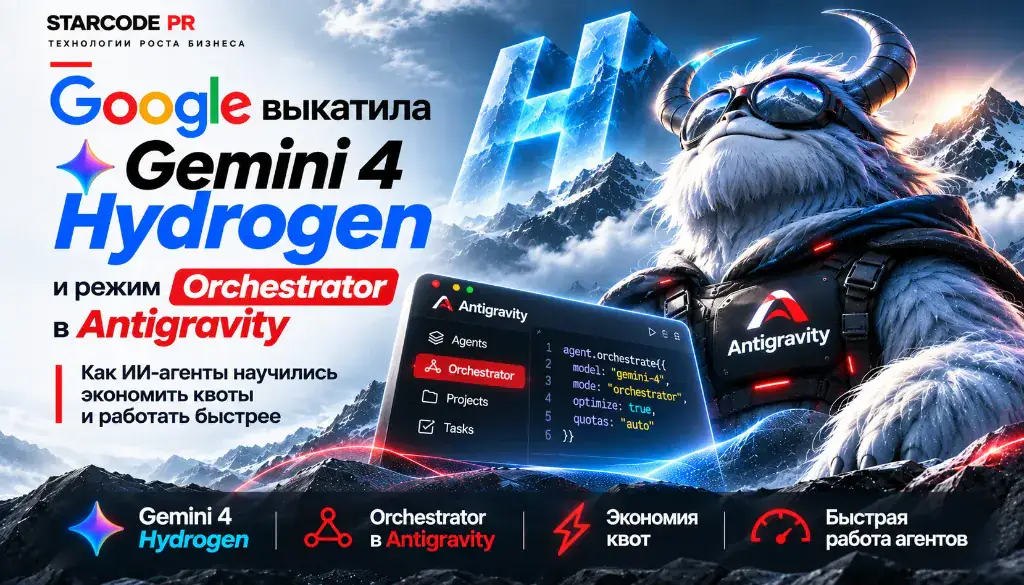
Gemini 4 Hydrogen: speed without compromising quality
Until now, developers had to choose between speed and depth of analysis. As noted in Google publications for developers, Gemini 4 Hydrogen closes this gap as the primary model for daily coding, debugging, dependency updates, and routine terminal operations.
Key performance metrics for the update according to Google and documentation on model selection in Antigravity:
Gemini 4 Hydrogen capabilities and benchmarks
How the Orchestrator works and why it is better than standard routers
A few days earlier, Google introduced the flagship Gemini 4 Carbon model along with the CLI command /swarm for running a swarm of parallel agents. However, running a heavy model for every minor step of a standard feature is inefficient: it slows down the development cycle and burns through limits too quickly.
The standard industry solution is static "model routers" that evaluate complexity based on the first prompt and send the entire dialogue to either a cheap or an expensive model. In the long run, this approach fails: a task might seem simple at the start but hit an architectural problem in the middle.
| Criterion | Static model router | Orchestrator mode in Antigravity |
|---|---|---|
| The moment of model selection | Once upon the first request before the session starts | Dynamic bidirectional switching on the fly |
| Reaction to hidden complexity | The weak model gets stuck or loops on a bug | A trigger is activated — context returns to Carbon or Argon |
| Speed and quota consumption | A heavy model overpays for routine edits and tests | 19% faster and 24% less quota on Terminal-Bench 4.1 |
The Orchestrator works differently — it uses dynamic bidirectional switching between a heavy model (Carbon or Argon) and the fast Hydrogen right in the middle of a session:
- Reconnaissance and plan (Carbon / Argon). A heavy model starts in read-only mode, studies the codebase, checks dependencies, resolves ambiguities, and creates a step-by-step plan. It includes built-in replanning triggers—conditions under which the executor must stop.
- Fast execution (Hydrogen). The completed plan is automatically passed to Hydrogen. The model writes code, makes file edits, installs packages, and runs tests.
- Safety net in case of error. If Hydrogen hits a test failure, an unobvious conflict, or triggers a plan condition, it returns the context back to Carbon or Argon. The senior model analyzes the project state, rebuilds the plan, and gives the routine back to the executor.
Google benchmarks: according to official Antigravity report on Terminal-Bench 4.1, the bundle in Orchestrator mode shows quality almost at the level of pure Carbon, while working 19% faster and consuming 24% less quota.
Custom pipelines in Antigravity SDK
For those building their own autonomous agents via Antigravity SDK, role allocation can be configured programmatically. For example, in an automated issue triage system, a pool of fast Hydrogen-based agents handles primary bug report analysis, repository searching, and minor UI edits based on Pull Request comments, while the heavy Carbon model is engaged only for major refactoring, designing new features, and security audits.
Availability and pricing
The update is already rolling out to paid plan users (current conditions and limits are listed on official Google Antigravity pricing page):
- Gemini 4 Hydrogen and Orchestrator (Argon) available to Google AI Pro, Google AI Ultra subscribers, as well as Gemini for business corporate clients.
- Orchestrator (Carbon) at launch, open to Google AI Ultra subscribers and corporate accounts.
The emergence of the Orchestrator marks a significant shift in the development of AI tools: instead of trying to solve every task with one giant neural network, the industry is moving toward bundles of specialized models where the architect and executor automatically back each other up in real-time.
At STARCODE, we are already using agentic pipelines in commercial projects — read more about implementation scenarios in our materials about autonomous AI agents for business and new format of AI-managed websites.
Need to implement AI agents or model orchestration into your workflows?
We design and configure reliable frameworks based on AI integration into business and process automation: we separate planning, verification, work with CRM/API, and quota management so that agents deliver measurable value to the team.
Sources and documentation
Sources verified .
- Google Antigravity: official platform page — Agentic development environment from Google with support for parallel agents, CLI, and multi-model orchestration.
- Google Blog: introducing Gemini 4 Hydrogen for agentic scenarios — Official announcement of the new fast model from November 12, 2026, key metrics, and reasoning levels.
- Google Developers Blog: rapid development with Gemini 4 Hydrogen — Practical use cases for the model for daily programming, debugging, and automation.
- Google Antigravity Blog: Gemini 4 Hydrogen and the Orchestrator mode — Analysis of dynamic switching between Carbon, Argon, and Hydrogen, speed metrics, and quota consumption on Terminal-Bench 4.1.
- Google Antigravity documentation: model selection and reasoning levels — Technical reference on low, medium, high, xhigh modes and model switching during a session.
- Google Antigravity documentation: /swarm command — Description of launching a parallel swarm of agents under a common coordinator based on Gemini 4 models.
- Google Antigravity SDK documentation: capability overview — Guide to programmatic building of custom agent pipelines and role allocation between models.
- Google Antigravity: Google AI Pro, Ultra pricing, and enterprise plans — Current availability conditions for Gemini 4 Hydrogen and the Orchestrator mode for private developers and teams.
The documentation describes platform capabilities. We check configuration and compatibility for the specific project; STARCODE prices and SLA are determined by our proposal and contract.