
Breaking down the under-the-hood mechanics of Agentic Browsing in Lighthouse
In May 2026, with the release of Lighthouse 13.3.0, a new category officially migrated to default checks (and then to PageSpeed Insights) — “Agentic Browsing”. It evaluates how ready your website is for interaction with AI agents, smart bots, and LLM models.
Many myths and unjustified panic have already emerged around this update. The Starcode PR team broke down the under-the-hood mechanics of the new audits to show: there's no need to rush to rewrite code right now, but knowing where Google is heading is a must.
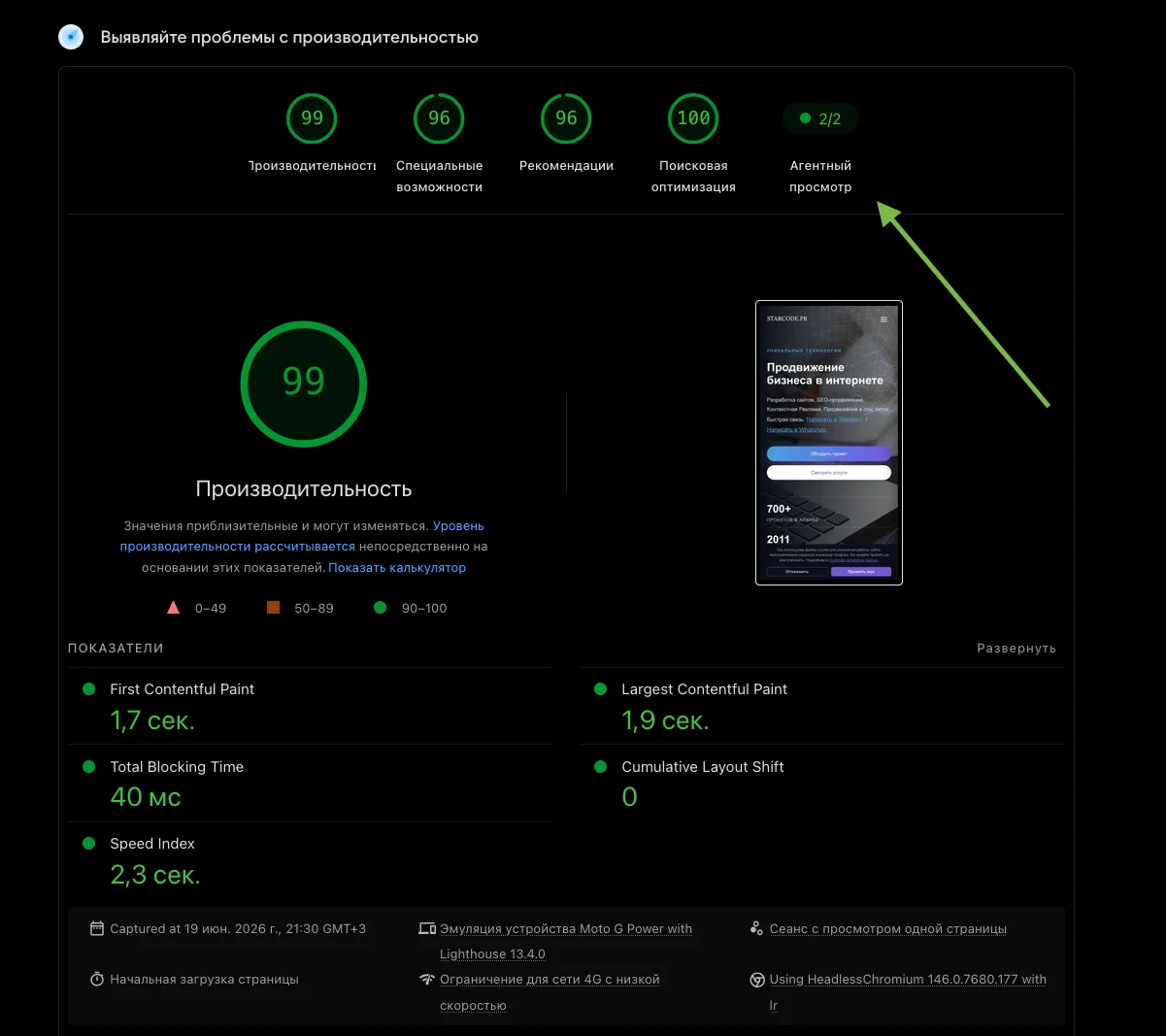
The main myth: “We will fall behind competitors if we don't implement AI features”
The "Agency View" category still has the status "under development". Unlike standard performance evaluation, there is no scale from 0 to 100 here. Lighthouse simply shows a fractional ratio of passed audits — for example, 2/2 or 3/3.
Important: You cannot “fail” an audit simply because you don't have trendy AI integrations. If the site lacks specific files or protocols for AI, Lighthouse will simply mark these checks as Not Applicable, and they won't spoil your score. A normal high-quality site easily gets green 2/2. This is a signal about the direction of web development, not a reason to panic.
4 real audits: What exactly does Lighthouse check?
In fact, "Agency View" boils down to just four specific metrics: two fundamental ones and two experimental ones.
1. Accessibility Tree correctness
Many articles try to break this item down into many new requirements, but in reality Lighthouse performs one familiar audit: «accessibility tree is not well-formed».
AI agents do not have eyes; their model of perceiving a page is the Accessibility Tree. This check is built on existing a11y (accessibility) rules. If you have correct semantics, buttons have aria-label, while forms are properly linked to <label>, you will pass this audit without extra effort.
2. Layout shifts (CLS — Cumulative Layout Shift)
The CLS metric has long been familiar to SEO specialists, but here it acquires critical meaning. If an AI agent found the desired button, calculated its coordinates, and attempted to "click", and at that moment a banner loaded and shifted the content, a software interaction failure will occur. Visual stability (CLS) is even more important for agents than for humans.
3. The llms.txt file (New standard)
This is the most interesting technical novelty that is often overlooked. llms.txt — is a file (by analogy with robots.txt), which is placed in the site root and contains a compressed Markdown summary of the project's structure and content specifically for large language models (LLMs).
If you decided to add llms.txt, Lighthouse will verify that it complies with three strict rules:
- The file must contain an H1 heading.
- The file must not be too short (meaningless placeholders are discarded).
- The file must contain links to your site's resources, strictly in Markdown format (for example,
[STARCODEPR.COM](/about)). Plain text URLs will lead to audit failure.
(Note: for now, this file is rarely used by AI tools themselves, so its absence will not lower your score).
4. WebMCP protocol
This audit checks how the website exposes its tools for interaction with models (Model Context Protocol). Lighthouse looks for tools registered on the page in two ways:
- Declaratively: Checks HTML forms for correct annotations and schema compliance (
form-coverageandschema-validity). If you specify tools via HTML attributes, they must have valid parameter names and descriptions (toolparamdescription). - Imperatively: The system picks up tools registered programmatically via JavaScript using a call
navigator.modelContext.registerTool.
What to do right now?
At the moment, "Agency View" is more of a compass than a supervisor. To keep your site in the green zone and ready for the future, focus on the basics:
- Keep CLS at zero. Strictly fix the dimensions of all images and ad blocks.
- Keep an eye on a11y. The accessibility tree must be ideal. This is beneficial not only for AI, but also for screen readers (and classic SEO).
- llms.txt and WebMCP — at your discretion. It only makes sense to integrate them if your project is already actively interacting with LLMs or you love being on the cutting edge of technology.