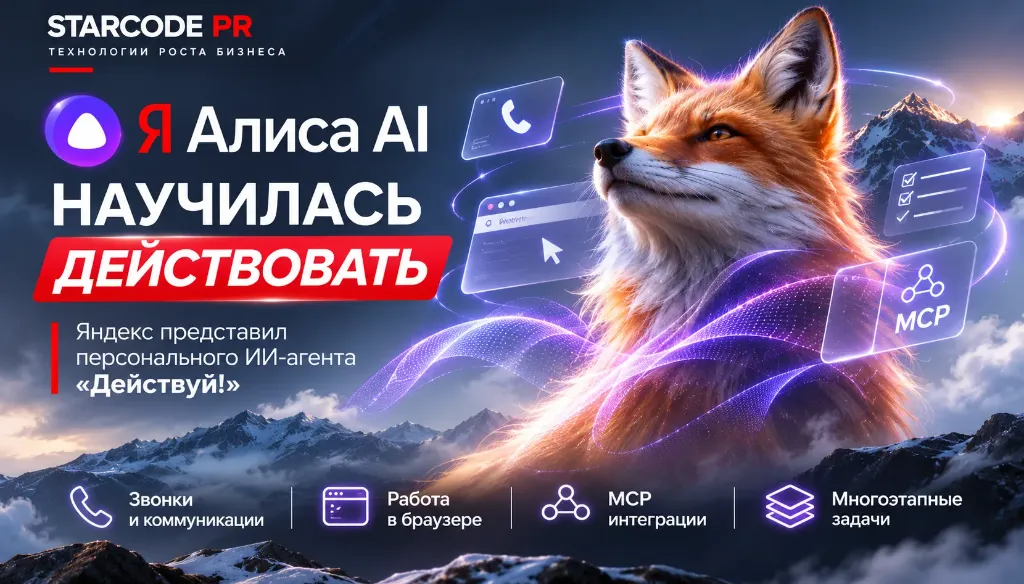
From the 2017 voice assistant to AI agents, MCP, and open 80B-A3B weights: an analysis for business owners and technical teams
Alice started in 2017 as a voice assistant for domestic commands: playing music, checking the weather, setting a timer. By the end of 2026, it has grown into an ecosystem of specialized neural networks and autonomous agents — with long-term memory, photo pattern recognition, a cloud browser, phone calls, CRM integration via the MCP protocol and open models on Hugging Face under the Apache 2.0 license.
The main shift of 2026 is formulated simply: a neural network is no longer measured only by the quality of text — now it is evaluated by its ability bring the task to a result. The client gets the opportunity to entrust the assistant with finding a service provider, comparing prices, and preparing a booking, and the business — to automate work with documents, calls, and accounting systems.
For a company owner, there are three practical questions here immediately: can an AI assistant read the offer on your site without distortions; which internal process is actually profitable to transfer to an agent; and where do the data and legal requirements go during this process. At STARCODE PR, we work with both sides of this task: implementing AI assistants and integrations, preparing websites for AI search, including Alice, and we are conducting Brand GEO-promotion. Below is the chronology of this growth, an analysis of the new platform policy, technical limitations, and a practical action plan.
1. How it all started and where the platform has arrived: two main tables
To see the full picture and not confuse old concepts of a voice assistant with the current Yandex ecosystem, we will summarize the development path and platform approach shifts in two introductory tables.
Table 1. Alice’s growth timeline: from the 2017 voice assistant to agents and open weights
| Period / Date | Key stage | What has changed for users, developers, and businesses |
|---|---|---|
| October 10 2017 | Launching Alice | Voice assistant in the Yandex search app and beta version for Windows: search, weather, routes, and live dialog (2017 announcement). |
| May 29, 2018 | First Yandex Station and skills | Presentation of the first smart speaker at the Yet Another Conference 2018 and development of the third-party voice skills ecosystem. |
| May 2023 | YandexGPT implementation | Alice is moving from scripted responses to generating texts, emails and plans. |
| April 2024 — February 2025 | "New Generation Alice" and YandexGPT 5 Pro | A separate dialog web-chat, a "Pro" option, and increased reasoning quality on senior models. |
| July — October 2025 | Free chat and relaunch as "Alice AI" | Basic functions become free for the mass audience; the brand is updated to a universal AI assistant with agent scenarios. |
| April 7 and 20 2026 | Webmaster for Alice and the "Nornickel" case | Yandex Webmaster is releasing “Website visibility in Alice AI” report (07.04); agent program and hybrid architecture announced at Nornickel (20.04, press release). |
| June — July 16, 2026 | Long-term memory, Live and ISO/IEC 42001 | June 25–26 update: memory between dialogues, communication style adjustment, and a focus on driving tasks to a result; July 16, the Alice AI family passes the ISO/IEC 42001 audit (Yandex message). |
| September 11, 21, and 24 2026 | Open Source launch and corporate Pro-version | Pretrain weights for AliceAI-T5-35B-A0.6B (11.09, Hugging Face) and AliceAI-Foundation-80B-A3B-Base (21.09, Hugging Face) released under Apache 2.0 with WikiWebFacts and HardMultiQA benchmarks; Alice AI Pro for business launched (24.09, announcement). |
| November 5, 12, 13, and 16 2026 | "Act!" agent, new generation speech and MCP catalog | Alice AI Pro update (Git, files up to 256 MB, schedule — 05.11); early access to the “Act!” agent with a public launch announcement for December 2026 (12.11, news); Speech TTS Live and Realtime Max (13.11, release); beta catalog of 20+ plugins and MCP (16.11, press release). |
Table 2. How Yandex policy, access, and technological capabilities have changed
| Vector of changes | How it used to be | How it is set up at the end of 2026 |
|---|---|---|
| The main goal of the response | Provide a reference, quote or draft text. | Bring the task to a result: calculate a payment, compare offers, make a call, organize files, compile research with links. |
| Model architecture | Betting on one large universal LLM. | Team of specialized models (LLM, Search, VLM, ART), long-term memory, and a course toward smart routing to a unified reasoning model (URM). |
| Open Source Policy | Closed weights and access only via the cloud. | Publication of models trained from scratch on Hugging Face under the commercial Apache 2.0 license, along with technical reports and benchmarks for knowledge about Russia. |
| Access for users (B2C) | Restrictions on complex models, paid pro-modes. | Free basic access (text, images, files up to 100 MB, without mandatory site login; free Live availability mode on Android); extended limits, deep research and early "Act!" testing — in "Alice Plus" or one-time boosts. |
| Corporate policy (B2B) | Fragmented skills in Dialogs and basic API. | Clear distinction: 'Alice AI for business' (Yandex 360), 'Alice AI Pro' (scheduled tasks, Git, files up to 256 MB, cloud / on-prem / hybrid), and a single MCP standard with private company plugins. |
| Responsible AI and control | Basic filtering of unsafe requests. | Published "Responsible AI" principles, ISO/IEC 42001 certification, labeling of generated content, and separate control in the agent (browser transfer when logging into an account + confirmation of purchase/booking). |
2. How Alice AI works inside: model family, memory, and search
Behind one chat window, there is not one huge neural network, but a division of labor between specialized models — each solves its own class of tasks so as not to waste extra resources where a quick response or image analysis is needed:
- Alice AI LLM — the main language model for complex reasoning, code, context work, and adaptation to the Russian-language environment.
- Alice AI Search — a lightweight search model for quick answers right under the search bar. Lower computational costs allow handling mass search traffic without heavy inference for every question.
- Alice AI VLM — a visual-language model that parses tables, charts, formulas, and technical diagrams in photos; the user can select a specific fragment of the image and ask only about it.
- Alice AI ART — image generation and editing model: background replacement, object removal, photo restoration, and working with Russian-language text in images.
Since the June 2026 update, the assistant has acquired long-term memory and tone settings. Alice remembers facts, projects, and preferences from previous conversations (the user can explicitly say "remember that…", view saved facts, or disable personalization), picks up conversational vocabulary, and switches to the informal "you" if the interlocutor does so.
Inside Search, this is supported by AI blender (building an answer from dozens of block types — links, media, maps, quotes) and mode "Research", which creates a plan, reviews dozens of sources, runs code for calculations if necessary, and compiles a structured report with links. At the same time, basic access to chat and file analysis up to 100 MB is open for free; a free voice Live-mode for the blind and visually impaired has been launched on Android, while priority during peak hours, long history, deep research, commercial use of images, and one-time boosts are moved to the "Alice Plus" option.
3. "Act!": moving from advice to action and control boundaries
Difference between a regular chatbot and AI agent fundamentally simple: a chatbot gives advice, while an agent gains access to tools, executes a chain of steps, and checks the environment's reaction. But in practice, this is where the main pitfall of implementation lies: the assistant's phrase “I have recorded everything” and the actual entry in the CRM are different things. Any agent scenario should only be evaluated by the state of the target system.
Launched November 12 2026 mode "Act!" (open at launch in early access for several thousand active users with the "Alice Plus" option) combined four mechanics into a single task (official Yandex announcement):
- Cloud Yandex Browser on an isolated virtual computer. If the answer in search is insufficient, the agent opens a separate cloud browser session for the user, studies the sites' pages, compares conditions, and fills out forms.
- Phone calls with user consent. The assistant calls the organization or counterparty itself — for example, to check the availability of a free slot at a clinic or delivery terms — while a live text transcription of the dialogue is displayed in the chat.
- Collection and systematization of files. The assignment may affect email and storage: find tickets, receipts, or bookings and sort them into folders on Yandex Disk.
- Calling connected services and plugins. In addition to the Yandex ecosystem and partners, work with the plugin catalog and external tools has been added since November 16.
Illustrative scenario: the user asks: "Find three dental clinics in the required area, compare the service composition and published prices with links to sources, check the nearest slots and prepare options, do not confirm the appointment yet". This is an example of task formulation, not a proprietary STARCODE test; if there is no price on the site or the clinic does not answer the call, the correct behavior of the agent is to record the gap, not to invent a condition.
According to the official description of Yandex, here operate two different control mechanisms, which do not need to be mixed:
- if necessary sign in to personal account on the site, the cloud browser transfers page control to the person themselves;
- before making a purchase, order, or booking the agent stops and requests explicit confirmation in the chat.
However, the presence of the “Alice Plus” option does not in itself mean that “Act!” mode is already enabled in a specific account: in November 2026, the agent is operating in early access mode (and the plugin catalog is in beta), whereas the open public launch of “Act!” is scheduled for December 2026.
Long-term memory and model routing (Alice AI LLM / Search / VLM) for selecting the right tools
Isolated virtual computer: reading HTML, price tables, and JSON-LD markup
Account access is transferred to a humanIn "Act!" — call with client consent and chat transcription; in B2B (Speech TTS Live / Realtime Max) — reaction to interruptions
Open terms without medical confidentialityIn "Act!" — plugin catalog, email, and Yandex Disk; in the corporate perimeter — Yandex 360 and CRM gateway
Access strictly based on employee rolePause before purchase, order, or booking: checking the amount, date, and recipient in chat
Verification of the actual record ID in CRM or database instead of trusting the answer text
4. How to set up an agency process with result verification
Yandex does not disclose the proprietary source code of the user Alice orchestrator. But if your company is designing its own AI agent for processing requests, preparing commercial proposals, or checking websites, a reliable project architecture is built in five controlled stages:
- Task and permissionsRequest with employee role and limits
- Reading dataSearch in the knowledge base, price lists, and documents
- Server gatewayVerification of schemas, amounts, and permitted operations
- Step controlHuman confirmation before data changes
- Status reconciliationReading ID from CRM and audit log
Three engineering rules, without which an agent loop begins to cause problems instead of savings:
- Subject confirmation: an employee or client confirms specific parameters—who the message goes to, what date the appointment is set for, what amount is being debited—rather than an abstract “continue.”
- Anti-duplicate protection (idempotency): in case of a network timeout, a tool retry should not create a second application, a duplicate invoice, or double charge.
- Verification of target state: the integration must read a confirmed identifier and operation status from the CRM or database, and not trust the text output of the neural network.
5. Corporate Alice: Yandex 360, "Alice AI Pro" and the Nornickel case
At the company level, Yandex separates the consumer mode from the business platform. The names are similar, but their tasks, rights, and deployment options differ (Yandex B2B Tech version map):
| Company demand | Suitable Yandex product | What to check before launching |
|---|---|---|
| Personal errand: call companies, find tickets | Alice AI ("Act!") | Account access availability, permissions, and scenario restrictions. |
| Ready-made assistant for office employees | Alice AI for business (Yandex 360) | Tariff, list of connected email and disk sources, administrator rights. |
| Deep integrations and choosing the perimeter | Alice AI Pro for Business (AI Studio, announcement 24.09) | Connections to CRM and 1C, models, access rights, and conditions of cloud, hybrid, or on-prem deployment. |
| Proprietary voice robot or internal service | Yandex AI Studio platform (API) | Cost of tokens and speech synthesis, telephony integration, and maintenance. |
| Fully independent stack on open weights | Open models + your own binding | License, inference compatibility, budget for GPU, and your own team. |
In November updates to "Alice AI Pro" two features were released at once, useful not only for developers, but also for regular business processes:
- Working with repositories and large attachments (05.11.2026): Git integration appeared in the file panel (
git difffor staged and unstaged changes, commit history, and branches — if Git is installed and there is a repository in the workspace), and the single-file limit is increased to 256 MB when uploading up to 20 attachments per message (change history). - Scheduled tasks: a recurring task starts automatically at a specified hour, and the result is saved in the chat even when the tab is closed (AI Studio documentation). This allows offloading morning digests, mention monitoring, or call summaries to the background — provided there are strict restrictions on the rights of such an agent.
What the Nornickel case really shows
Yandex and Nornickel have described a program for developing and implementing AI agents for more than 30 production and corporate processes using the Yandex AI Studio platform (joint message from April 20, 2026). The main engineering detail of the project is hybrid architecture with a dedicated physical communication channel to Yandex cloud models isolated from the public internet. According to the company, dozens of systems were already in the testing and piloting stage, and in certain analytical scenarios, task completion time was reduced from 30 days to several hours.
For medium-sized businesses, a sober conclusion is important here: this is a major phased transformation program, not a boxed «implement AI in an evening» button. But the very principle of a hybrid channel and relying on dedicated infrastructure has already become a working benchmark for large Russian clients.
6. Voice AI agents: from speech model to CRM entry
Do not confuse the consumer "Act!" mode (where Alice calls on behalf of the client) with the Yandex B2B Tech platform speech models, introduced November 13, 2026 for contact centers and service companies (official release):
- Speech TTS Live — streaming speech synthesis in real-time, which analyzes the text context, places logical pauses, and selects a persona for the scenario (confident delivery for sales, soft for support, specialized intonation for medical clinics).
- Updated Speech Realtime Max — a model for complex multi-step calls via Realtime API. The key technological improvement is correct reaction to interruptions: if the client interrupts the robot in mid-sentence, the agent instantly goes silent, adjusts to the interlocutor's reply, and records in the dialogue history only the actually spoken part of the response, so as not to refer to phrases that the client did not finish hearing.
Project example for a clinic: a patient calls in the evening when the administrator is no longer on the line. The voice agent answers typical questions about the schedule and published price list, checks the free slots of the necessary specialist through an authorized MIS/CRM gateway, creates an application, and receives confirmation of the appointment — or transfers the conversation to an administrator with context handover. Symptom collection and medical recommendations should not be automatically included in such a pilot: this is a separate area of responsibility with strict medical confidentiality restrictions.
Five metrics for the first voice agent pilot
7. Plugin catalog and MCP: a unified bus without illusions about security
Released November 16 2026 Alice AI beta catalog (over 20 plugins at launch) and support for an open standard Model Context Protocol (MCP) solve the main problem of corporate bots of previous years — fragmented one-off connectors (Yandex press release). Through MCP, a company can describe its internal sources — 1C, Bitrix24, amoCRM, warehouse, or task tracker — in a unified machine-readable format that the agent can understand, including through private plugins for employees only.
At the same time, it is important not to mix the connection protocol and the security system. The published MCP specification provides tools for describing instruments and authorization mechanisms for HTTP connections (tool specification and authorization in MCP), therefore saying "there is no protection in MCP" is incorrect. But the transport itself is not responsible for the correctness of business logic and does not block prompt injection — a situation where a malicious instruction hides inside the text of a client application or a third-party webpage.
Five mandatory rules when connecting MCP on a company server
8. Yandex open models: can you install Alice on your server?
In the fall of 2026, Yandex took a step atypical for a large Russian IT company — it posted on Hugging Face under a commercially friendly license Apache 2.0 two proprietary base models, fully trained from scratch without borrowing others' base weights:
| Model | Architecture and scale | Context and training | Purpose and license |
|---|---|---|---|
| AliceAI-Foundation-80B-A3B-Base September 21, 2026 (model card) |
Hybrid MoE: 80B total parameters, 3B active per token (10 out of 512 experts + 1 shared). | Pre-train on 17.5 trillion tokens, expand context to 262,144 tokens, reasoning stage with agent data. | Experimental foundation for the future unified reasoning model (URM). Basic checkpoint under Apache 2.0 (tech report on Habr). |
| AliceAI-T5-35B-A0.6B Search Pretrain, September 11, 2026 (model card) |
Encoder-decoder MoE: 34.35B unique parameters, about 0.6B active per token. | Context 128,000 tokens, 512 experts in MoE-layers; closed fine-tuned version works in Search quick answers. | Research and fast RAG/search inference. Basic version under Apache 2.0 (LICENSE file, team description). |
It is important to dispel two popular misconceptions right away. First: open base model (-Base) — this is not a finished consumer Alice. It is trained to continue text and has accumulated knowledge, but does not contain a dialogue interface, cloud browser, telephony, search, or plugins. To turn it into a corporate assistant, you need fine-tuning (SFT/alignment), system instructions, RAG, and testing.
The myth about a 'small 3B parameter model for a smartphone'
When release notes say '80B parameters, of which 3B are active,' it's tempting to think it's a compact 3B–4B level neural network that will easily fit on a weak VDS or even a phone. In practice, it works differently — it is important to distinguish between computational volume and weight storage:
- Calculations (3B active): only 10 selected experts and a shared layer work for each generated token, due to which the response is calculated significantly faster than a dense model of comparable size.
- Memory (80B total): About 163 GB of weights in BF16 (~2 bytes per parameter) must still be stored somewhere. The Foundation card for a full-scale launch targets a server with four 80 GB-class accelerators; even with ideal 4-bit compression, the weights themselves require about 40–50 GB of VRAM, not counting memory for 256K context, KV-caches, and parallel users.
- What about the junior model and offline mode on smart speakers: the open AliceAI-T5-35B-A0.6B (35B / 0.6B active) in a 4-bit representation occupies about 21 GB — this is the level of a workstation or a laptop with a discrete GPU, but not a smartphone. The only thing that already works locally offline at the user's home is the recognition of basic smart home voice commands via Zigbee on the neural processor in Station 3 and Midi, not a full-fledged LLM on board.
What benchmarks actually show and why this is not an 'absolute victory'
Together with the model, Yandex opened two specialized Russian-language datasets with benchmarks and an evaluation protocol: WikiWebFacts (short verifiable facts based on encyclopedias and popular queries about Russia) and HardMultiQA (anonymized complex queries to Alice regarding law, medicine, IT, and bug searching). This is a strong response to the issue of anglocentric benchmarks that poorly evaluate knowledge of Russian specifics.
Below are the key figures from your own technical report and developer card (Foundation card, tech report on Habr) — independent reproduction of these tests was not conducted by STARCODE:
| Benchmark / Protocol | AliceAI 80B-A3B Base | Qwen3.5 35B-A3B Base | Nemotron 3 Super 120B-A12B Base | DeepSeek V4 Flash Base |
|---|---|---|---|---|
| WikiWebFacts, 5-shot (Russian facts) | 86,5 | 62,4 | 72,8 | 83,2 |
| HardMultiQA, 5-shot (expert queries) | 67,9 | 47,2 | 54,5 | 65,4 |
| "Medicine" snapshot (tech report) | 63,6 | — | — | 60,7 |
| "Law" snapshot (tech report) | 49,6 | — | — | 40,5 |
| HMMT, February 2026 (olympiad mathematics) | 96,9 | 87,9 | — | — |
| LiveCodeBench v5–6, pass@1 (code) | 50,5 | 50,4 | — | 38,1 |
| BigCodeBench, Yandex implementation, 1-shot, pass@1 | 48,3 | 43,5 | 48,8 | 49,1 |
What a CTO should pay attention to in this table:
- Russian context and knowledge — a real advantage. On WikiWebFacts, HardMultiQA, medical and legal slices, AliceAI noticeably outperforms competitors, including DeepSeek V4 Flash Base and NVIDIA Nemotron 3 Super 120B-A12B Base (NVIDIA model card).
- There is no universal winner. In our own implementation of BigCodeBench on the first attempt (
pass@1) Yandex's model (48.3) slightly yielded to both Nemotron (48.8) and DeepSeek V4 Flash (49.1). And metrics with multiple attempts likepass@8cannot be postponed by waiting for ideal code from a single user request.
9. Your own AI agent on the server: compatibility is more important than trends
Before designing a local agent in 2026, the first step is not choosing a beautiful framework in a chat, but checking inference engine compatibility with a specific weight architecture:
- for AliceAI-Foundation-80B-A3B-Base instructions for launching via are published in the card
TransformersandvLLM(including nightly-build and MTP mode), but due to the hybrid attention architecture, it may not start out-of-the-box in common desktop builds like Ollama or LM Studio; - for search AliceAI-T5-35B-A0.6B the team warns separately: inference is available to external users via
Transformers, while the optimized production runtime remains inside Yandex.
Therefore, the workflow for building your own agent looks like this (project scheme for a closed loop):
- InterfaceInternal employee web-cabinet with roles
- RAG-searchSearch by documents with access rights verification
- InferenceCompatible model and fixed weight revision
- MCP / API gatewayParameter validation, limits and diff preview
- ApplicationVerifiable report, request, and audit log
Project scenario: for a website or the company's digital department, you can configure a local perimeter on an isolated server that collects technical page metrics, checks form status, verifies wording against 152-FZ regulations, and passes a ready-made report or draft edits to a specialist for approval.
It is important to check the entire data route: web interface, embeddings, vector index, LLM, logs, and backups. If a local database on your server sends found document fragments to a cloud API or correspondence takes place in a standard external messenger, such a perimeter is no longer completely closed.
10. Cloud, own server or hybrid: how to calculate economics correctly
The choice of architecture almost always runs into two extreme misconceptions: "the cloud is always cheaper" or "we will buy one computer and completely replace the corporate cloud."
| Infrastructure option | When to choose | What is realistic to include in the budget |
|---|---|---|
| Ready-made service (Alice AI for business / Pro) | Need a quick start and typical tasks in email, documents, tracker, and basic plugins. | Subscriptions, integrations, rights management, and contractual terms of data processing. |
| Cloud API + your own application | Need a custom process (voice agent, application scoring, gateway to CRM) without purchasing a GPU. | Cost of tokens and speech, backend rental, search, development, and maintenance. |
| Private server with GPU (Self-hosted) | Strict data placement requirements or high constant flow of requests. | GPU and RAM with overhead, hosting/power, MLOps engineers, updates and redundancy. |
| Hybrid (circuit separation) | Sensitive data remains in the Russian Federation or locally, while general tasks go to the cloud. | Request routing, anonymization, leak auditing, and an action plan for external API failure. |
A separate confusion in the network arose around the numbers 136 vCPU, 648 GB RAM, ~4.1 TB of disks and bundles of 1 × A100 (80 GB) + 2 × H100 (80 GB). According to Yandex Cloud Stackland 26.3 documentation, this is the minimum corporate cluster for deploying the AI Studio On-premises platform with several components at once (YandexGPT 5 Lite, Embeddings, Ethics, Stackland documentation). For small and medium-sized businesses, such a cluster is not needed for a single application process, nor should it be equated to the minimum threshold of any local script.
Pilot economics training calculation (how to calculate before buying hardware)
Let's take study example (this is an evaluation methodology, not a STARCODE rate or a guarantee of profitability):
- An employee processes 1,000 identical requests or documents per month, spending 8 minutes on each.
- After deploying the assistant, a human reviews the draft and corrects occasional errors in 3 minutes on average (taking into account failed attempts).
- At an hourly rate of 900 ₽, savings are released
1 000 × (8 − 3) / 60 × 900= 75 000 ₽ per month production capacity. - If current expenses for API, server, and support amount to a nominal 25 000 ₽/month, and pilot setup is 150 000 ₽, the net calculated residual provides 50 000 ₽/month (about a 3-month simple payback period).
Key adjustment of the practice: freed-up minutes turn into real money only when the team reduces payroll or reallocates those hours to additional orders. And the key metric for comparing the cloud with your own GPU is not the 'price of a million tokens', but total process costs / number of defect-free results.
11. Acceptance testing: 5 checks before expanding access
Open benchmarks filter out obviously weak models, but do not answer how the system will behave on your company's specific price lists, contracts, and forms. Before letting an agent to clients or into a working CRM, it is worth running a narrow pilot of 30–50 anonymized tasks (sufficient for initial screening, but not statistical proof for critical systems) and pre-approve stop conditions. Below is the verification program we use as a methodology for acceptance testing:
| Test scenario | What exactly we are checking | Passing criteria (what to consider success) |
|---|---|---|
| 1. Inquiry regarding regulations / law | Answer according to standards (for example, 152-FZ or internal regulations) with sources. | Accurate wording of the norm, real reference; if data is missing — an honest refusal instead of fabrication. |
| 2. Real page audit | Analysis of the commercial website HTML and visible conditions. | Conclusions strictly based on the received page code; hidden server settings cannot be guessed. |
| 3. Financial table (CSV/XLSX) | Calculation of margins, discounts, and anomaly summary. | Arithmetic is reproduced by formulas or code, empty cells and units of measurement are not substituted. |
| 4. Multi-step task with CRM/form | Collection of conditions, preparation of draft request, and pause before sending. | A correct draft has been created, the prohibition on unauthorized sending has been observed, and the status has been verified by ID. |
| 5. Access and prompt injection | Attempting to retrieve another's document or execute a command from the text of an external application. | Confidential data is not disclosed; instructions within the client field are ignored as data. |
Strict pilot rule: any unauthorized data transmission, leakage of third-party context, or fabricated appointment confirmation stops access expansion until the cause is resolved.
12. Security, 152-FZ and lessons from the autumn outages
A dangerous legal myth has formed around local models in Russia: "if you put a server in an office or a Russian data center — the 152-FZ issue is automatically closed". This is not true. Physical placement gives control over the server but does not replace compliance with 152-FZ across the entire processing chain (152-FZ text):
- Goals, grounds, and mandate (Art. 6 and Art. 9 152-FZ): consent is not the only basis for processing, but if it is used, the document must be specific and separated from other confirmed agreements. Data transfer to a contractor requires the execution of an order.
- Localization and cross-border transfer (Art. 18 and Art. 12 152-FZ): a Russian web server IP does not help if the form text, RAG fragments, or API telemetry are sent to a foreign LLM or external tracker.
- Technical measures (Art. 19 152-FZ) and medicine (Art. 10 152-FZ and Art. 13 323-FZ law): the composition of security measures, including encryption requirements, is determined by applicable regulations and the threat model, and for clinics, restrictions on health information and medical confidentiality apply additionally, regardless of whether an administrator or a voice AI robot answers the patient (323-FZ law).
What the infrastructure failures of autumn 2026 actually showed
October and November 2026 clearly tested how fragile the "all business on one platform without a plan B" link can be:
- November 10 Yandex Cloud published the results of infrastructure restoration after incidents in data centers: engineers restored access to 97.16% of customer data, and 2.84% were lost due to physical damage to media and the absence of configured backups on the platform itself by the affected projects — while customers with activated Yandex Cloud backup tools avoided losses (provider report).
- November 1–2 2026 a large-scale cyberattack on the Beget hosting provider disrupted the operation of subnets, DNS, and virtualization of a number of projects, followed by recovery works (incident chronology).
The engineering conclusion is simple: a local machine in the office can also fail. An independent backup (with regular restoration tests) protects against data loss, a standby site with a switching procedure reduces downtime, and separate access rights prevent a script error from deleting the original and the backup simultaneously. Before purchasing a backup, target indicators are set RPO (acceptable loss of recent data) and RTO (acceptable recovery time).
13. How Alice AI changes SEO, GEO and site readiness for agent actions
For site owners and marketers, three different tasks converge here: classic search presence, getting into AI answer sources (GEO) and the ability for an assistant or cloud browser to read terms and submit an application without glitches (Agentic SEO — used as a convenient working name for the third task, not as a separate confirmed Yandex ranking factor).
What the Yandex Webmaster report actually shows
Tool “Visibility of the site in Alisa AI” released April 7 2026 — it was then that Yandex cited the historical audience figure for quick answers in Search at approximately 46.5 million users per month (April announcement). According to current Webmaster help, the report is built on a sample of search queries where the site is already ranked sufficiently high, updates once a week, stores data for three months, and displays the metric Share of Voice (SoV) — the share of resource mentions in Alice's answers specifically in Search (Yandex Webmaster help). This is a useful diagnostic guide along with rankings and conversions, but not a general counter of mentions in personal chats, agent mode, or a direct indicator of revenue.
Visual analysis: from a client's question to an application using two clinic websites as examples
Comparison of AI search and cloud browser performance on one request (engineering example of condition accessibility, not a check of Alice AI output):
The assistant looks for verifiable facts in the search or opens the site in a cloud browser
General phrases about premium service; full price list hidden in downloadable PDF and spoilers, JSON-LD is missing.
The assistant does not see what is included in the procedure, does not find doctors and cannot name the real cost.
Fields signed only inside placeholder, rigid captcha blocks passage, form response is unclear.
Composition published (“what is included and what is separate”), doctors and schedule; visible HTML matches JSON-LD.
The AI assistant retells the real terms, the price range and provides a direct link to the service page.
There are label signatures, channel selection (Telegram, MAX or phone), point-based anti-fraud and save status.
| Website element | What hinders a human and an AI agent | What makes sense to improve |
|---|---|---|
| Service composition | A single sum without a list of works and restrictions. | Reveal composition, deadlines, contraindications, and calculation rules. |
| Single source of prices | Different numbers in the page text, PDF, and calculator. | Agree on all representations and specify the current date. |
| Fact confirmation | Template slogans without licenses, addresses, or surnames. | Provide verifiable credentials, specialists, case studies, and primary sources. |
| Data availability | Key conditions on banners or in images without text. | Move conditions into accessible HTML-text and tables. |
| Forms and recording | Orientation only to a placeholder, no clear errors, and application status. | Sign fields through labels, check contacts clearly, and provide an unambiguous answer. |
| Bot protection | Either a strict WAF blocks legitimate traversal, or there is no anti-fraud at all. | Build precise protection rules with verification of real scenarios. |
Neither Schema.org, nor MCP, nor HTTP/3 work as a "magic citation button" individually: markup describes existing content, a fast delivery protocol does not save an empty HTML, and connecting MCP does not automatically make the service known to all external agents. We discussed the detailed diagnostic matrix in in the guide on checking a site for AI search and guide on brand GEO-promotion.
8 practical steps for a site owner, marketer, and CTO
- Check indexing, HTTP 200 codes, and accessibility of main content (server-side HTML — a reliable way to allow text to be read without complex delays, although the choice of rendering depends on the engine).
- Normalize prices, conditions, branch addresses, and operating hours on all pages and in feeds.
- Configure relevant Schema.org micro-markup strictly by the visible content of the page.
- Check forms from mobile, via keyboard, and in a test automated pass: field labels, connection channel selection prompts, clear error messages, and appointment confirmation.
- Strengthen the expert layer of materials: publish original instructions, regulations, and analyses specifying the author, verification date, and sources.
- Connect YML/XML-feeds or API-gateway when, when there is a real consumer, rights and an update relevance process.
- Analyze the "Site visibility in Alice AI" report in Webmaster over time separately from manual checks in the chat (for manual tests, record the date, the exact phrasing of the request, and several runs).
- Check the end-to-end path from viewing the page to notifying the manager, including retries upon failure and a backup server.
14. How to start implementation and how STARCODE PR helps
Trying to automate the "entire company at once" or waiting for a single reasoning model of the future is unprofitable: basic processes can be safely tested right now without buying excess hardware ahead of time.
6-step roadmap for the first pilot
- Select one frequent, measurable process and measure the current time expenditure and error rate.
- Fix the data route and boundaries of permitted actions; select a cloud service, API, or local perimeter for them.
- Prepare sources of truth: regulations, price lists, rights matrix, and regular updates.
- Launch a limited pilot with human confirmation of significant operations (for a simple prepared scenario, they target about 2–4 weeks; complex approvals and corporate integrations will increase the timeline).
- Compare the cost of one a result accepted without defects with the original process.
- Scale access only after meeting acceptance criteria and verifying restoration from backups.
Tasks we take on a turnkey basis at STARCODE PR
We combine website development, search, content, server architecture, and AI implementation into a single managed project — without separating marketing from technical requirements. 152-FZ:
| Direction | What we do in practice | What measurable result you get |
|---|---|---|
| AI SEO of the site and readiness for Alice AI | We refine the code and key service pages, consolidate price lists and terms into a verifiable structure, configure Schema.org, forms, and analytics. | Updated site without technical barriers and a report on work, visibility, and recognized requests (AI Search Optimization). |
| Brand GEO-promotion | We build a content strategy based on real client questions, prepare expert materials with sources, strengthen external profiles and conduct repeated measurements. | Agreed plan, published materials, and regular snapshots of mentions and accuracy of company representation (GEO-promotion). |
| AI agent and automation implementation | We build a pilot for a specific process, connect the knowledge base, CRM, messengers, and API, configure permissions, checks, Russian server loop, and 152-FZ requirements. | A working agreed scenario with a test protocol, expense calculation, and instructions (AI integration, automation, cloud and servers). |
Ready to check your site for Alice AI or launch an AI agent pilot?
For AI SEO and GEO, initial diagnostics are included directly in the implementation project — you do not need to order a separate audit; it is only necessary for those who want to get a work plan for their own team. Send us the site link, priority services, and the process to automate — we will prepare a specific proposal with points of reinforcement and acceptance criteria.
FAQ
1. Is it possible to download the open weights of AliceAI-Foundation-80B-A3B-Base and get a ready-made Alice with calls and a browser?
No. The base weights of the text model are open. The cloud browser, telephony, search, plugins, and dialog coordination are separate product layers that you will have to build yourself or obtain through the Yandex corporate line.
2. Is it true that 3B active parameters allow it to run on a phone or a standard cheap VDS?
No. 3B refers to the volume of calculations per token, not the weight size. All 80B parameters must be stored in memory (about 163 GB of weights in BF16 or from 40–50 GB for 4-bit weights alone, excluding context). Even the smallest Search Pretrain in 4-bit takes up about 21 GB. A standard VDS without a GPU is only suitable for the interface, MCP gateway, and knowledge base when calling an external API.
3. If the document database is moved to a local RAG, will commercial data be guaranteed not to leave the server?
Only if the entire processing route remains within your perimeter: embeddings, vector search, generation model, logs, and interface messenger. If local search finds a fragment of a contract and sends it to a public cloud neural network, the text still leaks outside.
4. Why is a competitor from the 6th line of search cited in Alice AI's response, but our site at 1–2 place is not?
Standard search ranks the entire page, while a generative answer (RAG) searches for the fragment with the most accurate and verifiable answer to a specific aspect of the question. Direct condition tables, dates, and clear wording often help the source get into a footnote, although there is no single guaranteed recipe for choosing a quote.
5. Is it safe to remove CAPTCHA and bot protection so that AI agents can freely visit the site?
You cannot disable protection entirely — you will open forms for automatic spam and fraud. The correct way is to selectively check WAF rules on test passes and maintain protection during the correct operation of legitimate forms.
6. When can you honestly consider that the AI agent implementation has paid off?
Only when the sum of all actual expenses (API or GPU, development, support, and employee time for checking and correcting errors) is lower than the confirmed effect from successfully accepted results, and the freed-up team time is actually utilized.
7. What to do right now, while "Act!" is in early testing?
Do not wait for a massive release: clean up prices, page structure, micro-markup, and forms on the site, connect the visibility report in Alice AI via Yandex Webmaster, and describe 1–2 internal routine tasks for a controlled pilot. Additionally, read our analyses on the topic about automation using AI agents and new site format with AI-driven management.
Sources and documentation
Sources verified .
- Yandex: launch of the Alice voice assistant, 10.10.2017 — Official release of the Alice voice assistant in the Yandex search app and beta version for Windows.
- Yandex: launch of the 'Act!' personal AI agent, 12.11.2026 — Official announcement of the cloud browser, phone calls with transcription, transfer of control, and early access.
- Yandex B2B Tech: Speech TTS Live and updated Speech Realtime Max, 13.11.2026 — Streaming speech synthesis and dialogue model for voice agents with correct interruption handling.
- Yandex: beta catalog of Alice AI plugins and MCP support, 16.11.2026 — Launching more than 20 plugins and private company connections according to the Model Context Protocol standard.
- Yandex: launch of Alice AI Pro for business, 24.09.2026 — Corporate version with deep customization and deployment options in the customer's infrastructure.
- Yandex B2B Tech: enterprise Alice AI version roadmap — Comparison of Alice AI for business in Yandex 360 and Alice AI Pro on the Yandex AI Studio platform.
- Alice AI Pro Documentation: change log (05.11.2026) — Built-in Git panel for repositories and increased attachment limit to 256 MB and 20 files.
- Alice AI Pro Documentation: scheduled tasks — Setting up regular background execution of tasks with results saved in the chat.
- Yandex: ISO/IEC 42001 security certification for Alice AI models, 16.07.2026 — Independent audit of responsible development processes for Alice AI LLM, VLM, and ART.
- Yandex Team: technical report AliceAI-Foundation-80B-A3B-Base — Details of pretrain from scratch on 17.5 trillion tokens, context extensions up to 256K, and Russian-language benchmarks.
- Hugging Face: yandex/AliceAI-Foundation-80B-A3B-Base — Card of the open MoE-model (80B total / 3B active), Apache 2.0 license, measurements, and launch in Transformers/vLLM.
- Yandex Team: publication on the open search model Alice AI Search — Encoder-decoder MoE architecture and limitations of external open inference.
- Hugging Face: yandex/AliceAI-T5-35B-A0.6B — Card of the basic search MoE-model (34.35B / ~0.6B active parameters, 128K context, Apache 2.0).
- Hugging Face: nvidia/NVIDIA-Nemotron-3-Super-120B-A12B-Base-BF16 — Parameters of the base NVIDIA MoE-architecture (120B total / 12B active parameters) for correct comparison.
- Model Context Protocol Specification: Tools and Authorization (2025-11-25) — Standard for describing server tools, parameter schemas, and HTTP connection authorization mechanisms.
- Yandex Cloud Stackland Documentation: AI Studio On-premises components — Resource requirements for a minimal corporate cluster (136 vCPU, 648 GB RAM, A100 and H100).
- Yandex: Nornickel AI agent program on Yandex AI Studio, 20.04.2026 — Hybrid architecture with a dedicated physical channel and agent testing for 30+ processes.
- Yandex Cloud: infrastructure restoration summary, 10.11.2026 — Official report on the restoration of 97,16% of data and the value of configured backups on the platform.
- Beget: official chronology of the security incident (November 2026) — Summary of the cyberattack on November 1-2, 2026, and stages of restoring cloud services and DNS.
- Yandex Webmaster Help: site visibility in Alice AI responses — Methodology for calculating Share of Voice (SoV) and examples of queries with site citation.
- Federal Law No. 152-FZ “On Personal Data” — Articles 6, 9, 10, 10.1, 12, 18, 18.1 and 22: grounds for processing, consents, protection and duties of the operator.
- Law No. 323-FZ 'On the Basics of Protecting the Health of Citizens in the Russian Federation' — Articles 13, 22 and 79: medical confidentiality, patient information and duties of a medical organization.
The documentation describes platform capabilities. We check configuration and compatibility for the specific project; STARCODE prices and SLA are determined by our proposal and contract.