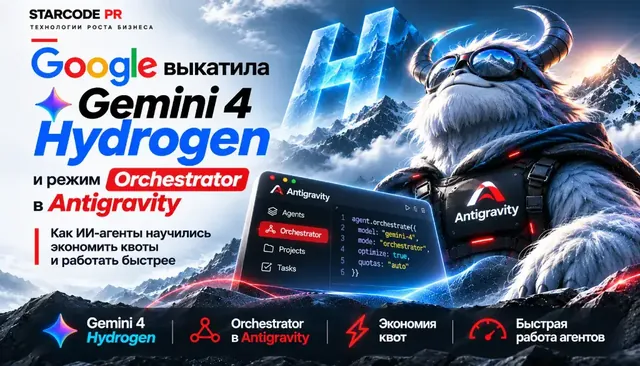
Neon, Carbon, Hydrogen and Argon — how Google distributes tasks between models and what business gets
On November 18, 2026, Google DeepMind introduced Gemini 4 Neon — a model that closed the main gap in the Gemini 4 lineup: between the ultra-fast everyday Hydrogen and the heavy long-reasoning flagship Carbon a balanced "center of gravity" has emerged for production development, analytics, and autonomous business agents.
At the same time, the team updated the two-way mode Orchestrator in Google Antigravity (a combination of the Neon planner and Hydrogen executor), expanded the user agent Tasks in Gemini in six countries and recorded new records on independent ratings Coding Agent Index and Zapier AutomationBench. We break down the lineup architecture, real test figures, and implementation economics for companies.

1. Gemini 4 Neon: new model for complex code and autonomous agents
Most commercial development and corporate analytics are exactly in the middle: tasks are too complex for ultra-light models, but too frequent to wait for a slow flagship at every minor step. According to Google, Gemini 4 Neon was designed specifically for this "golden mean" — it maintains quality at the level of larger models, reduces unnecessary file reads in repositories, and reliably compresses long context without losing the essence.
Technical parameters and security of Gemini 4 Neon
High, and for complex debugging, it is enabled xhigh; in addition, Neon took 2nd place in controllability (steerability) — adequately accepts corrections right during the execution of the task.xhigh the model repelled all attacks (0.0% successful hacks) when attempting to substitute instructions through web pages, emails, or code.2. Carbon, Argon, Neon and Hydrogen: how Google distributes tasks in the Gemini 4 lineup
With the release of Neon, the Gemini 4 family architecture was finally formalized by task "weight class". Instead of a universal expensive model for all occasions, Google splits the load between four models of varying depth and cost.
| Model | Main role | Context and modes | API rate per 1 million tokens |
|---|---|---|---|
| Gemini 4 Carbon | Heavy flagship: architecture, science, formal verification, and vulnerability audit | Long horizon, multi-step self-verification loops | $4.00 input / $20.00 output standard from December 1 (introductory rate $2.00 / $10.00 until November 30; cache −95%) |
| Gemini 4 Argon | The senior corporate model for complex universal tasks (in the Gemini app, it has been replaced by Neon) | High analysis accuracy and multimodal scenarios | $4.00 input / $20.00 output standard from December 1 (introductory rate $2.00 / $10.00 until November 30; cache −95%) |
| Gemini 4 Neon | Working standard for code, agent planning (Orchestrator), automation, and analytics | 1M context, Low / Medium / High / xhigh, Batch −50% | $3.00 input / $15.00 output; context cache $0.15 (paid API tier only) |
| Gemini 4 Hydrogen | Fast executor for mass edits, tests, /swarm workers and free Tasks | High response speed, saving limits and quotas | $1.50 input / $7.50 output; context cache $0.075 |
3. Gemini 4 Carbon: deep reasoning, software architecture and scientific tasks
To understand where the boundary between Neon and the senior flagship lies, it is worth looking at the cases of Gemini 4 Carbon. This model was created not for quick UI edits, but for tasks with a high cost of error, where the algorithm must propose hypotheses itself, look for logical contradictions, and verify proofs:
- Formal code verification: based on Carbon, researchers built the AlphaProof Code agent circuit, which generated millions of lines of code in the Lean language and mathematically proved key security properties of the cryptographic protocol Signal in a few weeks instead of years of manual expert work.
- Cyber protection and 0-day vulnerability search: the Google Cloud Vulnerability Research (CVR) team used Carbon to check cloud SaaS providers — the model found critical 0-day vulnerabilities and logic errors in open-source repositories in less than two hours.
- Scientific and laboratory research: in protein modeling on the CASP17 set, Carbon increased the number of found remote homologs by 40 times without retraining the base models, and in biotech, it helped diagnose reagent mixing errors from raw laboratory logs.
The conclusion for commercial IT teams is simple: Carbon is justified in rare architectural analyses, cryptography, and deep security audits, and 80–90% of daily engineering tasks closes faster and 32% cheaper Neon.
4. Neon + Hydrogen bundle: how Orchestrator and the /swarm team work
The most notable practical feature for developers and agencies is the update of the mode Orchestrator in Google Antigravity blog. Now two models can work in a pair in one session Neon + Hydrogen, automatically separating the "brain" and the "hands":
- Planning and reconnaissance (Gemini 4 Neon). The senior model analyzes the repository structure, checks contracts and dependencies, formulates a step-by-step plan, and immediately sets recovery points in case of deviations.
- Massive execution (Gemini 4 Hydrogen). A fast model writes boilerplate and application code, updates configs, sets dependencies and runs unit and integration tests with minimal delays.
- Automatic insurance in case of failure. If tests fail or an architecture conflict occurs, Hydrogen does not loop, but returns control Neon — the coordinator re-checks the status and adjusts the plan.
- Parallel agents via /swarm. When a project splits into independent modules (e.g., backend API, frontend, integration and auto-tests), the lead agent on Neon deploys a swarm of workers in isolated branches with a shared coordination board.
For internal services, the same scheme is easy to transfer to a custom pipeline via Antigravity SDK. We talked about the mechanics of two-way orchestration in more detail in the previous analysis launch of Gemini 4 Hydrogen and Orchestrator.
5. New test results: Neon's leadership in coding and business automation
The main signal of this release for business — Neon leads not in abstract "olympiad questions", but specifically in agent tests, where the model itself walks through tools, terminal, SaaS systems and multi-step regulations:
| Benchmark / Index | Neon result | What exactly does the test check |
|---|---|---|
| Artificial Analysis Coding Agent Index | #1 worldwide (58.6 points) | Complex work of full-fledged coding agents in real repositories, debugging and CLI operations |
| Zapier AutomationBench | #1 worldwide (56.3%) | End-to-end automation between simulated SaaS systems: CRM, email, helpdesk, HR, and finance |
| Artificial Analysis Intelligence Index | #3 worldwide (61 points, xhigh) | General reasoning index (#2 on the price/quality Pareto front) |
| Agent Arena Index & SWE-sweep | #2 (1336) / up to 39.0% in Antigravity | Evaluation of 4,200+ real agent sessions; on SWE-sweep, switching from simple scaffolding (12.8%) to Google Antigravity tripled the result |
| Andon Labs Vending-Bench 2 & analytics | #1 ($16 843) · 73,5% Chartography · 75,8% Docs | Long business simulation of operational management, reading dense financial charts and corporate PDFs |
Practical takeaway from the SWE-sweep test: the same model showed 12,8% in a primitive shell and 39,0% inside a full-fledged Google Antigravity environment. In production, the result is provided not by a "magic prompt", but by proper agent scaffolding with tests, isolated sandboxes, and step control.
6. Tasks in Gemini: a personal agent for calendar, invoices and purchases
Parallel to developer tools, Google began rolling out a massive consumer agent — Tasks in Gemini mode (a switch Chat ↔ Task directly in the Gemini app).
- Free launch in 6 countries: access is already open for free to hundreds of millions of users in the USA, India, Canada, Australia, Japan, and South Korea based on the fast model Gemini 4 Hydrogen, and in paid Google AI Pro/Ultra subscriptions, it accelerates complex multi-step instructions Gemini 4 Neon.
- Calendar, mail, passwords and invoices: with access to Google Workspace, the agent can analyze accumulated PDF invoices in Gmail (e.g., detecting a spike in electricity usage due to heat pump peak hour operations), find an open slot in Google Calendar, and manage personal or work errands.
- Purchases and payments via AP2: via Google Shopping Graph, the agent compares specifications, refines parameters (power, color), searches for working promo codes, and completes the purchase via Google Pay using the protocol Agent Payments Protocol (AP2) tokenized card with user-defined limits.
- Regional restrictions and security: a portion of real-action functions — calls to auto repair shops and companies with a mandatory disclosure that an AI is calling, SMS/RCS commands, forwarding to
gemini@google.comand direct Google Pay payments — in the first stage, they are being deployed mainly in the USA (18+). All processing takes place inside hardware-isolated microVMs in Google Cloud with mandatory confirmation of critical actions.
For companies working in the Russian jurisdiction and under 152-FZ requirements, it is important to consider the same user wave in parallel with the development of domestic platforms — we wrote about them in detail in the review of the Alisa AI "Act!" agent and the MCP-plugin catalog.
7. What business gets: token economics, websites, SEO/GEO and document management
According to the published of the official Gemini API price rates, the main benefit of the new architecture for business consists of three levers of savings:
- −32% cost per task versus Carbon: the Neon rate is $3 / $15 per million tokens versus $4 / $20 for standard Carbon/Argon since December; with the same reasoning quality, the company spends approximately a third less on each work cycle.
- Context caching with a 95% discount: re-reading cached context costs only $0,15 per million tokens for Neon and $0,075 for Hydrogen. Brand instructions, database schemas, product catalogs, and regulations are passed to the model practically for free.
- Batch mode (Batch / Flex) with a 50% discount: nighttime price recalculation, auditing thousands of product cards, and parsing accumulated logs cost half as much as the standard API.
In practice, for STARCODE PR projects, such a multi-model scheme (coordinator + fast executors) already fits into three key areas:
- Website development and integration (web development, API integration). Neon is responsible for module architecture, code review and complex DB queries, while Hydrogen/orchestrator collects templates, adaptives and runs regression checks.
- SEO and GEO automation (SEO promotion, GEO in neural networks). Batch analysis of thousands of pages, generation of multilingual Schema.org markup, update
llms.txtand regular audit of brand citations in AI-search without overpaying for "heavy" tokens. - Processing documents, estimates, and requests in CRM (neural network implementation, process automation). Uploading PDF contracts, invoices, Excel spreadsheets and correspondence into a unified 1M window with extraction of structured data into CRM/1C and mandatory cross-check before action.
Do you want to implement AI agents or optimize token consumption for your business tasks?
At STARCODE, we design turn-key agent circuits: we separate roles between heavy and fast models, connect context caching, MCP/API-integrations with CRM, and a website for a stable result without wasting budgets.
Sources and documentation
Sources verified .
- Google Blog: official announcement of Gemini 4 Neon (18.11.2026) — Key benchmarks, API prices, 1 million context tokens, 4 thinking levels, protection against prompt injection and integration with Tasks in Gemini.
- Google Antigravity Blog: Gemini 4 Neon, Orchestrator (Neon + Hydrogen) and /swarm — Analysis of the Neon planner and Hydrogen executor combination, saving 32% of the cost per task compared to Carbon, and examples of /swarm.
- Google Blog: launch of Gemini 4 Carbon for deep reasoning, science and cybersecurity — AlphaProof Code and formal verification of the Signal protocol in Lean, searching for 0-day CVR vulnerabilities and CASP17 scientific research.
- Google Blog: introducing Gemini 4 Hydrogen for agentic scenarios — Official announcement of the new fast model from November 12, 2026, key metrics, and reasoning levels.
- Google DeepMind: technical card of the Gemini 4 Neon model (PDF) — Architecture, security parameters, limits and summary evaluation tables.
- Artificial Analysis: Coding Agent Index ranking — Independent evaluation of agent development stacks, where Gemini 4 Neon took 1st place with a score of 58.6.
- Zapier: AutomationBench benchmark — Independent testing of end-to-end business process automation between SaaS systems and APIs, where Neon took 1st place with 56.3%.
- Google Blog: free launch of Tasks in Gemini in 6 countries and new agent functions — Working with calendar, Gmail, purchases via Shopping Graph and Google Pay/AP2, isolation in microVMs.
- Gemini API documentation: current rates for tokens and context caching — Official rates for Hydrogen, Neon, Carbon, and Argon, 95% discount for context caching and Batch mode.
- Google Antigravity documentation: /swarm command — Description of launching a parallel swarm of agents under a common coordinator based on Gemini 4 models.
- Google Antigravity SDK documentation: capability overview — Guide to programmatic building of custom agent pipelines and role allocation between models.
- Google Antigravity: Google AI Pro, Ultra pricing, and enterprise plans — Current availability conditions for Gemini 4 Hydrogen and the Orchestrator mode for private developers and teams.
The documentation describes platform capabilities. We check configuration and compatibility for the specific project; STARCODE prices and SLA are determined by our proposal and contract.